
Joshi: Japanese Particles助詞
Grammar drills for the JLPT
App Store →iOSFree app with an in-app purchase
Knowing what に means is not the same as knowing when it is で. Nine hundred sentences, one blank, four particles – until the right one arrives on its own.
What it looks like
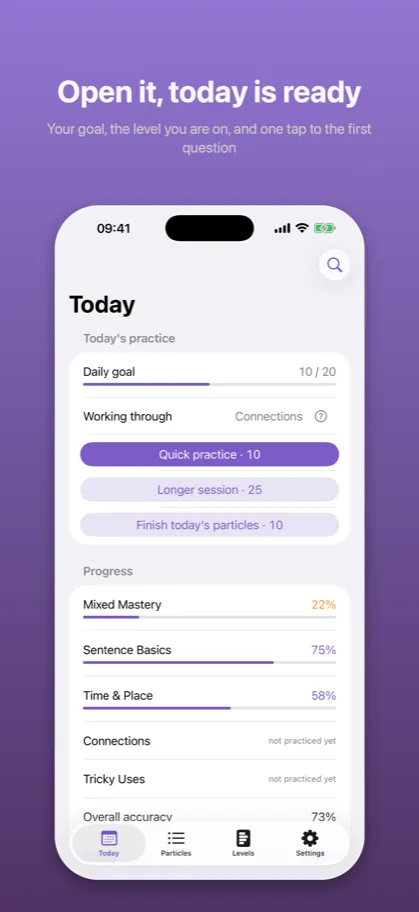
A short daily session, starting at your level
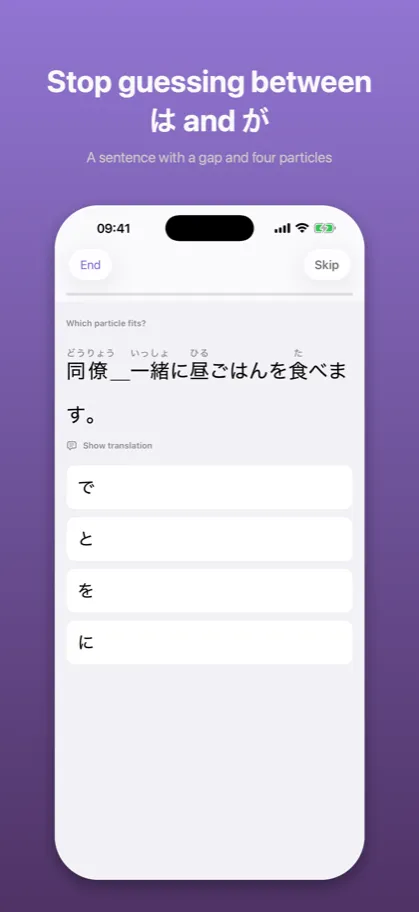
Four choices. Decide what works in this sentence.
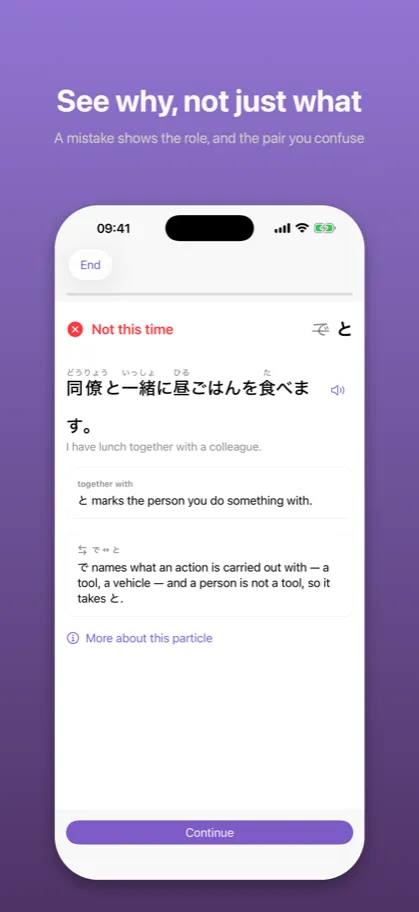
The full sentence, the particle’s role and why the other one fails
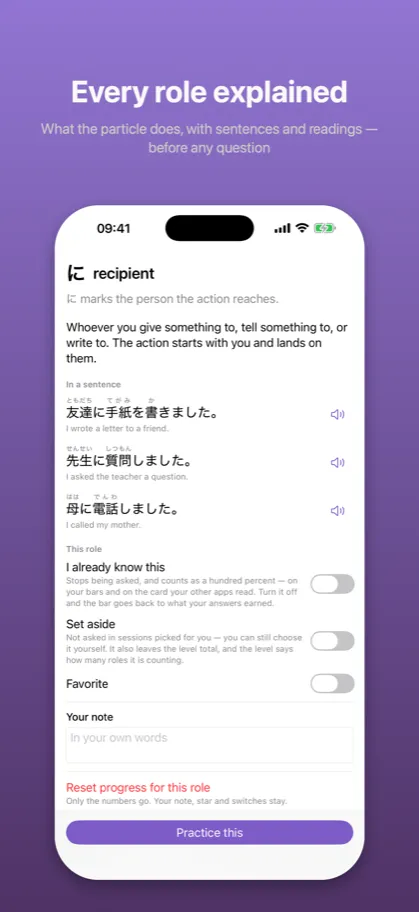
What the particle does, with sentences and readings, before any question
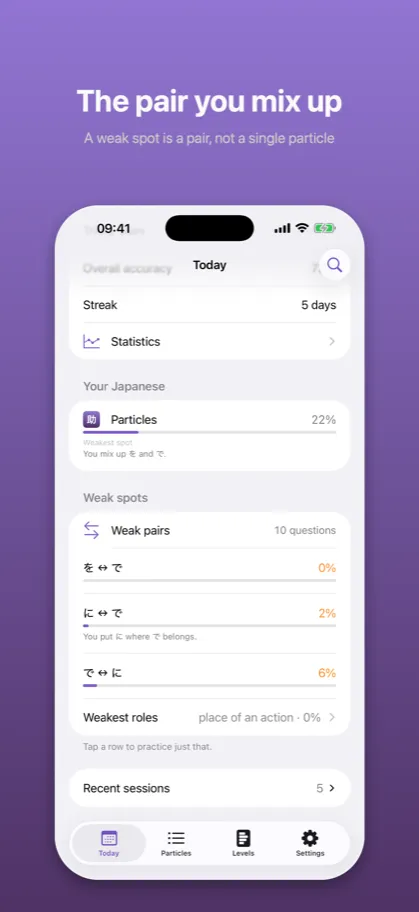
A weak spot is a pair, not a single particle
Description from the store
Japanese particles are not a list to memorise. Each one changes what the sentence is about.
You can know that に marks a destination and で marks where an action happens, and still hesitate every time. Understanding a rule and reaching for it without thinking are two different skills, and only the second one gets you through a sentence.
HOW IT WORKS
A natural Japanese sentence with one particle missing. Four options. Tap one.
学校_勉強します。 に で を へ
Then, immediately: the sentence with the particle in place, what that particle is doing there, and – if you picked a particle people genuinely confuse it with – why that one does not fit here.
WHAT YOU PRACTICE
Twelve particles across forty distinct uses. は, が and を and the roles they play in a sentence. に and で and the line between where something is and where something happens. へ, と, も, の, から, まで and や. Then the same particles doing less obvious work: を with a route you walk along, を with a place you leave, に with the purpose of going somewhere, で with a cause, と closing a quotation, の turning a whole clause into a noun.
THE PART THAT IS DIFFERENT
Most apps can tell you that に is at 61%. That number does not tell you what to do.
Joshi tracks confusion pairs – two uses that get mistaken for each other – as a thing in their own right. So instead of "practice more に", it can say に ↔ で needs work, and then serve you the sentences where one is right and the other is tempting. Weak pairs are their own practice mode.
WHY THE WRONG ANSWERS ARE FAIR
A wrong option has to be genuinely wrong in that sentence. A particle that would produce correct Japanese with a different meaning is not a distractor – it is a second answer, and a question with two answers teaches you something untrue. That rule cost this app a confusion pair and a number of otherwise good sentences, and it is the reason you can trust the red cross when you see one.
READINGS AND HINTS
Furigana over the kanji, so an unfamiliar word never turns a particle question into a vocabulary question. The English translation sits hidden behind a tap by default, because with it visible you match the particle to the English and practice something else without noticing. Both are settings: never, always, or on tap.
Every sentence can also be heard. A speaker button reads it in Japanese, using the reading the catalog knows rather than a guess at the kanji. No network needed.
PROGRESS THAT MEANS SOMETHING
Mastery is capped by how much evidence there is, so three lucky taps do not read as mastered. Five levels, twelve particles and thirteen confusion pairs each get their own bar. Nothing here counts questions answered.
No coins, no gems, no energy, no streak you can lose by taking a day off.
FREE AND PAID
Levels 1 and 2 are free in full – は, が, を, に, で and へ, which is most of the particles in an ordinary sentence. One purchase, once, opens levels 3 to 5, weak-pair practice and the whole question pool.
SENTENCES, WITH AI
The Sentences tab has two modes. Explain takes any sentence – from a manga, subtitles or scanned from a photo – and shows what each particle does in it, named after a role from this app. Check mine assesses a sentence of your own: each particle is marked right, wrong or "works, but…", with a short why and the fix. Five requests a month are free; more come with the AI Help subscription: PLN 9.99 monthly or PLN 79.99 yearly, auto-renewing, cancellable in your Apple Account settings. Levels and exercises do not depend on it.
PRIVACY
No account. No adverts. No analytics. Learning works offline, and your progress and your list of sentences stay on your device – you can export your progress whenever you like. Only the Sentences tab talks to our server, sending just the sentence; the server does not store it.
TERMS
Terms of Use (EULA): https://www.apple.com/legal/internet-services/itunes/dev/stdeula/ Privacy Policy: https://jd-japanese.pl/joshi/1.5/en/privacy.html
The description above is the same text that stands on the App Store product page – it comes from the same file.
App Store →iOSFree app with an in-app purchase
Common questions
What does Joshi teach?
Japanese particles are not a list to memorise. Each one changes what the sentence is about.
You can know that に marks a destination and で marks where an action happens, and still hesitate every time. Understanding a rule and reaching for it without thinking are two different skills, and only the second one gets you through a sentence.
What does Joshi cost?
Levels 1 and 2 are free in full – は, が, を, に, で and へ, which is most of the particles in an ordinary sentence. One purchase, once, opens levels 3 to 5, weak-pair practice and the whole question pool.
Does it work without an account or a network?
No account. No adverts. No analytics. Learning works offline, and your progress and your list of sentences stay on your device – you can export your progress whenever you like. Only the Sentences tab talks to our server, sending just the sentence; the server does not store it.
Learning Japanese
- Japanese particles: は, が, を, に, で, へ – The particles that carry an ordinary Japanese sentence, and the roles they stand in – with examples and translations.
Documents
The other apps
- Kaname: Japanese Grammar — JLPT practice: N5 N4 N3 N2 N1
- Bunmyaku: Japanese Reading — Vocabulary, kanji, furigana
- Katsuyokei: Conjugation — Verbs, adjectives and drills
- Kazoekata: Japanese Counters — Counting, kanji and drills
- Kuzushi: Casual Japanese — Anime, drama and slang
- Shindan: Japanese Level Test — JLPT placement: N5 N4 N3 N2 N1
- Keigo: Polite Japanese — Formal Japanese for work
- Kifuku: Japanese Pitch Accent — Pronunciation and listening
- Onomatope: Japanese Mimetics — Manga and anime vocabulary